
I am a PhD student in Digital Transformation and Innovation (DTI) at the University of Ottawa. My research is driven by one question: how do systems built on past information respond to a world that continues to change?
My training in law and finance first exposed this tension. Rules and models are written from what is already known, yet they must govern or predict what has not yet happened. My later work in AI psychology carried the same question into artificial intelligence, where I began treating AI systems as cognitive and behavioral agents whose reasoning can be probed experimentally.
My current work applies this lens to large language models. Once trained, an LLM is largely frozen, while the information environment it depends on keeps moving. My research on Generative Engine Optimization (GEO) treats that gap as an experimental lever, asking how an already-trained model responds when the information reaching it is new, contradictory, or deliberately manipulated.
Warning
Problem: The current name of your GitHub Pages repository ("Solution: Please consider renaming the repository to "
http://".
However, if the current repository name is intended, you can ignore this message by removing "{% include widgets/debug_repo_name.html %}" in index.html.
Action required
Problem: The current root path of this site is "baseurl ("_config.yml.
Solution: Please set the
baseurl in _config.yml to "Education

Education


News
Selected Publications (view all )

“What Happens, What Helps, What Hurts”: A Qualitative Analysis of User Experiences With Large Language Models for Mental Health Support
Yimeng Zhang, Xu Li, Junfeng Zhu, Zhongzhen Sheng, Tony Rousmaniere
Practice Innovations 2026
This study qualitatively examines users' experiences with large language models for mental health support, focusing on what users perceive as helpful, harmful, and consequential in their interactions with these systems.
“What Happens, What Helps, What Hurts”: A Qualitative Analysis of User Experiences With Large Language Models for Mental Health Support
Yimeng Zhang, Xu Li, Junfeng Zhu, Zhongzhen Sheng, Tony Rousmaniere
Practice Innovations 2026
This study qualitatively examines users' experiences with large language models for mental health support, focusing on what users perceive as helpful, harmful, and consequential in their interactions with these systems.

Wenchuan Earthquake Enhanced Collectivistic Expression in People's Daily
Penghao Mao, Junfeng Zhu, X. Ren
Proceedings of the 11th International Conference on Behavioural and Social Computing (BESC), IEEE 2024
This study tests whether language-based psychological signals reflect a general response to real-world crises by extending the analysis to the Wenchuan earthquake. The results show that large-scale textual data can capture shifts in collective psychological states following acute societal trauma.
Wenchuan Earthquake Enhanced Collectivistic Expression in People's Daily
Penghao Mao, Junfeng Zhu, X. Ren
Proceedings of the 11th International Conference on Behavioural and Social Computing (BESC), IEEE 2024
This study tests whether language-based psychological signals reflect a general response to real-world crises by extending the analysis to the Wenchuan earthquake. The results show that large-scale textual data can capture shifts in collective psychological states following acute societal trauma.
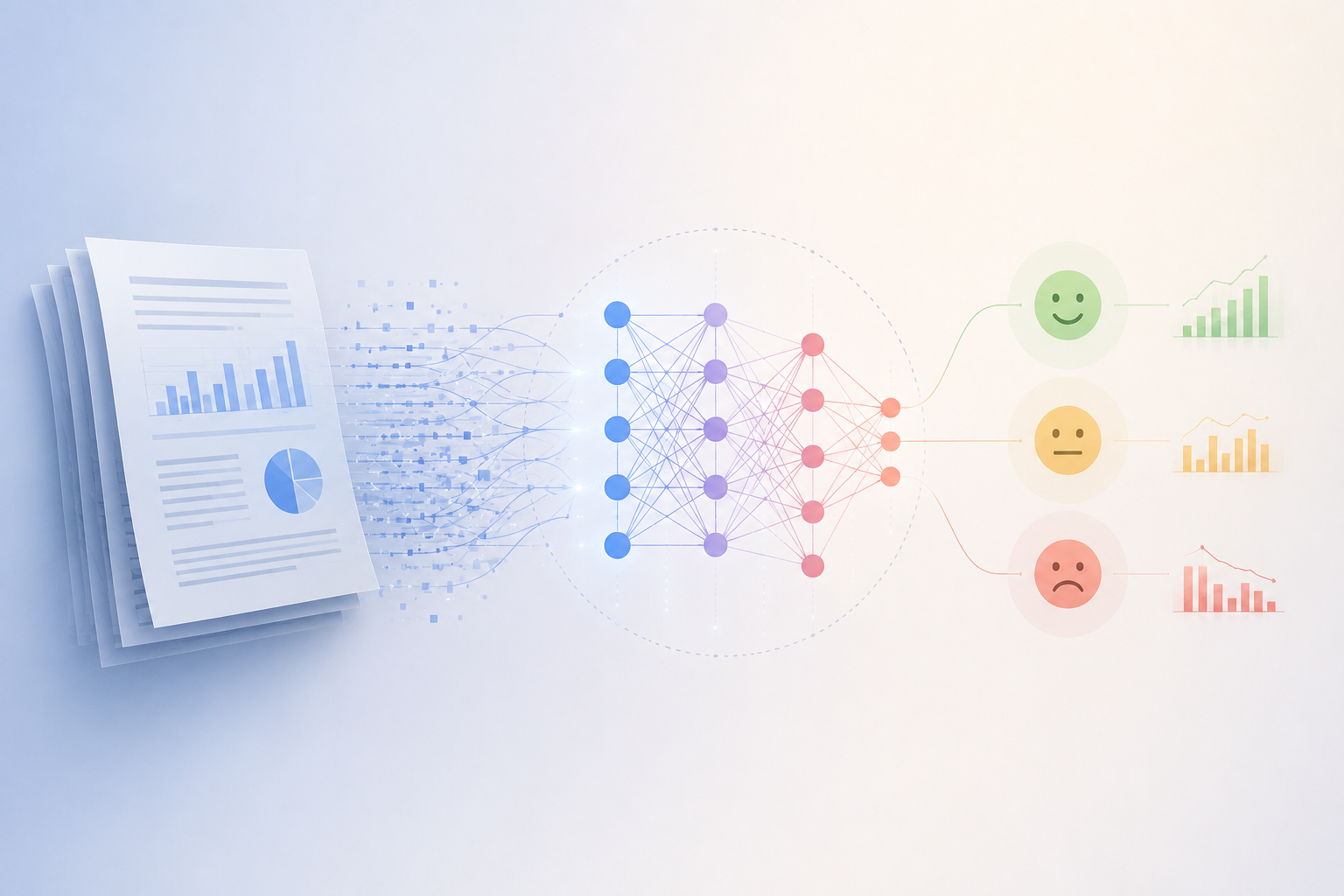
Machine Learning Approach to Sentiment Recognition from Periodic Reports
Junfeng Zhu, X. Ren
Proceedings of the 3rd International Conference on Computer Communication and Artificial Intelligence (CCAI), IEEE 2023
abstract: >- Using data from 4,142 publicly offered mutual funds in China, this study constructs a fund-manager sentiment index from periodic reports using natural language processing. The results show that managers’ positive and negative market sentiment signals are closely associated with stock-market movements, demonstrating the potential of NLP to measure psychological variables at scale.
Machine Learning Approach to Sentiment Recognition from Periodic Reports
Junfeng Zhu, X. Ren
Proceedings of the 3rd International Conference on Computer Communication and Artificial Intelligence (CCAI), IEEE 2023
abstract: >- Using data from 4,142 publicly offered mutual funds in China, this study constructs a fund-manager sentiment index from periodic reports using natural language processing. The results show that managers’ positive and negative market sentiment signals are closely associated with stock-market movements, demonstrating the potential of NLP to measure psychological variables at scale.